


Arjun Awasthi, Ian Akash Morrison, and Sangeeta Awasthi, Avesta Bio, March 21, 2026
Executive summary
RLIP76 is best understood not as a narrow or isolated topic, but as an expanding field of biology with increasing translational relevance. The modern RLIP76 field traces back to foundational studies by Sanjay Awasthi, Sharad Singhal, and collaborators beginning in 1994. Those early papers established ATP-dependent transport functions distinct from P-glycoprotein, identified human RLIP76 as the transporter itself, and later linked RLIP76 to drug resistance, radiation sensitivity, endocytosis, kidney cancer biology, tumor neovascularization, and systemic metabolic regulation, including the 2010 Diabetes paper on glycemic control.[33-41]
Over the past decade, however, the field has matured well beyond its original investigator base. Rather than remaining confined to the originating research network, RLIP76 research has seen increasing adoption by independent external investigators, with growing citation, broader authorship, and expanding scientific engagement over time. This pattern is important because it is often characteristic of meaningful scientific and therapeutic advances: foundational discoveries frequently require years or decades of validation before broader recognition and eventual commercial translation emerge. Read in that context, the RLIP76 field reflects both enduring scientific relevance and a growing base of external validation.
That expansion is visible both in scale and in scope. There are currently over 450 publications listed on PubMed related to RLIP76/RALBP1, with RLIP76 now the more commonly used name for the gene RALBP1. This memo deliberately focuses on 32 of the most directly relevant post-2015 papers authored by researchers outside of Avesta’s internal research group.[46] Critically, however, the direct-mention bibliography understates the broader downstream footprint of the field. A simple title search for “RLIP76” does not capture many later papers that build on concepts first established in the originating RLIP76 program—glutathione-conjugate transport, stress defense, drug resistance, endocytosis, angiogenesis, and RAL-effector biology—without explicitly naming RLIP76 in the title. Citation data from just four foundational papers by Sanjay Awasthi already sum to at least 288 citation instances, illustrating that the field’s downstream scientific reach is substantially larger than the direct-title literature alone.[55-58] In total, Dr. Sanjay Awasthi’s abstracts and papers have been cited over 16,500 times, and his H-index is 72 (See Appendix A).
The strongest and most mature branch of this external literature remains oncology. Over the last decade, independent investigators have repeatedly connected RLIP76 to aggressive disease behavior, relapse risk, apoptosis resistance, invasion, metabolic adaptation, and therapy response across breast cancer, colorectal cancer, prostate cancer, gastric cancer, melanoma, oral cancer, glioblastoma, glioma, meningioma, and renal cancer models.[1-4,7-15,20,26,44,45] Notably, at least one non-originating paper as early as 2012 explicitly described RalBP1 as a promising novel therapeutic target in colorectal cancer.[44]
At the same time, the field has diversified materially beyond direct oncology phenotypes into a broader RAL-signaling and stress-response landscape. External work now spans Ral-effector interface mapping, peptide and binding-domain engineering, cargo exocytosis, mitochondrial fission, angiogenesis, hypoxic HIF-1/VEGF control, oxidative stress, Alzheimer’s disease-related proteinopathy, perioperative neurocognitive injury, and epilepsy.[6,9,16-23,27-32,42-45] This mechanistic diversification is one of the clearest signs of field maturation: RLIP76 is no longer discussed only in direct knockdown or cancer-specific contexts, but is increasingly embedded in broader biology relevant to trafficking, mitochondrial dynamics, angiogenesis, and CNS stress response. Adjacent commercial development is also emerging. Machavert, for example, describes a first-in-class RAL GTPase inhibitor program, reflecting translational interest in the broader RAL-RALBP1 axis in which RLIP76 functions as a central effector.[30,47,48]
Taken together, the evidence suggests a field that was historically concentrated in one originating research network but is now materially broader in authorship, disease coverage, mechanism, and translational relevance. Oncology remains the most mature area of external validation, but the most important shift since 2015 may be the widening of RLIP76 into multiple adjacent biological domains.[1-4,7-15,20,26][17,18,22,23-29,42-45] Viewed against the historical development arcs of HER2, VEGF, and PD-1, the maturation trajectory of RLIP76 is consistent with how target fields often evolve: foundational biology first, mechanistic expansion second, and broader translational relevance emerging over one to two decades.[49-54]
Field development at a glance
| Period | Dominant emphasis | Representative publications |
| 1994-2004 | Foundational RLIP biology: transporter function, stress defense, drug resistance, radiation response, endocytosis, and early links to tumor and metabolic biology. | Awasthi 1994; Awasthi 2000; Awasthi 2003 [33-35] |
| 2005-2014 | Expansion of RLIP biology into disease relevance: neovascularization, glycemic control, cell migration, mitochondrial signaling, prognosis, and early independent uptake into cancer-related biology. | Singhal 2009; Diabetes 2010; Goldfinger 2006; Kashatus 2011; Mollberg 2012; Lee 2014 [36-45] |
| 2015-2017 | Early external oncology expansion: expression, knockdown, apoptosis, invasion, and chemosensitivity studies across multiple tumor types. | Breast, colon, prostate, meningioma, BBB, gastric, melanoma, colorectal, and blebbishield papers [1-13] |
| 2018-2021 | Pathway and structural maturation: broader RAL-network framing, interface work, binding-domain engineering, and continued disease-focused oncology studies. | Oral cancer, GBM, stapled peptides, affinity maturation, RLIP76 and RAL reviews [14-18,30] |
| 2022-2026 | Diversification into hypoxic metabolism, cargo exocytosis, oxidative stress, mitochondrial dysfunction, perioperative neurocognitive injury, ageing, Alzheimer’s disease, and epilepsy. | Glioma hypoxia, Science Advances exocytosis, AD and epilepsy papers [19-29,31-32] |
- Historical research context: discovery and creation of the RLIP field
Like most key oncology targets, RLIP76 did not enter the literature as a late-stage biomarker. It entered first as a mechanistic protein. Foundational work from 1994 onward showed ATP-dependent transport of anthracyclines and other xenobiotics by a mechanism distinct from P-glycoprotein, identified human RLIP76 as the transporter itself, and then linked RLIP76 to glutathione-conjugate transport, drug resistance, and radiation sensitivity.[33-37] These studies created the core thesis that RLIP76 is not simply associated with stressed or malignant cells, but participates directly in how they manage toxic metabolites and survive therapeutic injury.
From 2009 through 2012, the originating program moved beyond biochemistry into target-validation biology. Author-linked publications positioned RLIP76 as a kidney-cancer target, connected RLIP76 to systemic glycemic control in Diabetes, showed a requirement for RLIP76 in clathrin-dependent endocytosis and chemical carcinogenesis, and linked RALBP1 / RLIP76 depletion to reduced tumor neovascularization in vivo.[38-41] For much of this interval, the published RLIP literature appears to have been concentrated in the originating group and close collaborators, which is typical of a field in its earliest phase of definition.
By the early 2010s, however, independent external investigators were already widening the biological frame. Goldfinger and colleagues connected RLIP76 to adhesion-dependent Rac activation and cell migration.[42] Kashatus and co-workers placed RALA and RALBP1 in mitochondrial fission at mitosis.[43] Mollberg and colleagues reported that RalBP1 overexpression predicted poor colorectal-cancer outcomes and explicitly identified it as a promising therapeutic target.[44] Lee and Goldfinger later linked RLIP76 to HIF-1 function, VEGF secretion, and angiogenic activity of the tumor secretome.[45] By the time the post-2015 external corpus begins, RLIP76 had already started to diffuse into the broader cell-biology, angiogenesis, and cancer literature.
- Evolution of the external literature, 2015-2017: primarily oncology-oriented
The 2015-2017 external literature is the period in which RLIP76 becomes visible as a recognizable field outside the originating network. Multiple groups associated RLIP76 with malignant behavior across several tumor types. A breast-cancer paper described RLIP76 expression as a prognostic marker, while a meningioma study reported that overexpression was required for proliferation and associated with recurrence.[1,4] In parallel, functional studies in colon cancer, prostate cancer, gastric cancer, melanoma, and colorectal-cancer models showed that reducing RLIP76 expression, or targeting it through microRNAs, inhibited growth, increased apoptosis, suppressed invasion, or enhanced chemosensitivity.[2,3,7,8,11,12]
This early external period was still primarily oncology-oriented, but it already contained clues that RLIP76 biology was broader than tumor proliferation alone. A blood-brain barrier endothelial-cell study showed inflammation-dependent modulation of RLIP76-linked transporter biology, and thermodynamic mapping of RalA and RalB effector interfaces provided context for how RLIP76 fits into the larger RAL pathway.[5,6] A 2017 blebbishield paper then placed RalBP1 inside a survival program relevant to oncogenic transformation and cellular plasticity.[13]
Taken together, the 2015-2017 literature established three points that have remained durable. First, RLIP76 disease relevance was repeatable across tumor types rather than confined to a single malignancy. Second, multiple groups were seeing consistent themes: cell survival, apoptosis resistance, invasion, and therapy response. Third, the field was already beginning to connect those disease findings back to pathway architecture rather than treating RLIP76 as a one-off marker.[1-13]
- Mechanistic maturation and pathway expansion, 2018-2021
Between 2018 and 2021, the literature became more mechanistically organized. The RAL GTPase review led by Theodorescu framed the broader pathway as therapeutically important in cancer, and the subsequent International Review of Cell and Molecular Biology article extended the RAL-signaling discussion beyond oncology.[18,30] Within the RLIP76-specific literature, the 2021 review in Cancers synthesized the protein’s domains, transport properties, and signaling functions, reinforcing the view that RLIP76 should be understood as a multifunctional platform rather than a single-purpose factor.[17]
This period also produced more concrete evidence that RLIP76-adjacent biology could be approached at the level of interaction surfaces. A 2016 Journal of Biological Chemistry paper described stapled-peptide inhibition of Ral GTPases, and a 2021 follow-on study used affinity maturation of the RLIP76 Ral-binding domain to inform the design of peptide-based Ral inhibitors.[9,16] These papers did not yet define a mature RLIP-specific drug class, but they materially changed the tenor of the field: the literature was no longer limited to showing that RLIP76 mattered biologically; it was starting to examine how RAL-RLIP interfaces might be exploited experimentally.
Disease-focused studies continued in parallel. External investigators implicated RALBP1 in oral-cancer biology through Akt and microRNA regulation, while increased RLIP76 expression in IDH1 wild-type glioblastoma was associated with worse prognosis.[14,15] This combination of continued disease signal and growing pathway tractability is important because it marks the transition from a discovery field to an interpretable mechanism field. It is also in this period that the broader RAL axis begins to show translational pull outside academia: Machavert, associated with Dan Theodorescu, describes a first-in-class RAL GTPase inhibitor program now in commercial development.[47,48] Although that effort is adjacent to RLIP76 rather than RLIP76-specific, it underscores that the surrounding signaling architecture is being taken seriously as drug-development territory.[30,47,48]
- Broadening of the field, 2022-2026
From 2022 forward, the external literature broadens in two major directions. The first is stress-adaptive tumor biology. In glioma, RLIP76 was shown to stabilize HIF-1alpha, promote glycolysis, and support tumorigenesis under hypoxia, linking the target to metabolic adaptation rather than only proliferation or invasion.[20] A renal-cancer study later tied RLIP76-initiated Ras / ERK and Akt / mTOR signaling to sunitinib resistance and cell motility, extending the literature on treatment response and pathway control.[26]
The second direction is trafficking and membrane dynamics. The 2023 Science Advances paper on a Reps1-Ralbp1-RalA module showed that Ralbp1 participates directly in cargo exocytosis and surface-protein homeostasis.[22] This paper is especially important for field evolution because it supports a broader interpretation that had been building for years: RLIP76 is not simply a transporter or a stress-response marker, but part of a functional machinery governing how cells handle cargo, signaling complexes, and membrane turnover.[17,18,22,42,43]
Substantial CNS-oriented literature also emerges in this period. Reviews and primary studies connected Rlip biology to oxidative stress, mitochondrial dysfunction, Alzheimer’s disease-related proteinopathy, perioperative neurocognitive disorders, and epilepsy.[19,21,23-29] This newer branch does not displace oncology as the dominant evidence base, but it materially expands the scope of the field. RLIP76 is now being studied as a stress-and-trafficking regulator with relevance across cancer, ageing, neurodegeneration, perioperative injury, and pharmacogenomics.[19-29]
- Signals of field adoption and scientific momentum
Several indicators show that RLIP76 has moved beyond a narrow originating literature into a broader scientific footprint. The field now has enough non-originating work to support a focused external review on its own terms, while still tracing clearly back to the originating discoveries. The table below summarizes the most useful current markers of momentum.
Momentum indicators
There are several key indicators that momentum is building towards widespread adoption of the main thesis behind RLIP76 inhibition. They reveal that scientists globally have been increasingly adopting the same understanding that RLIP76 is a valid and important target for cancer and other diseases.
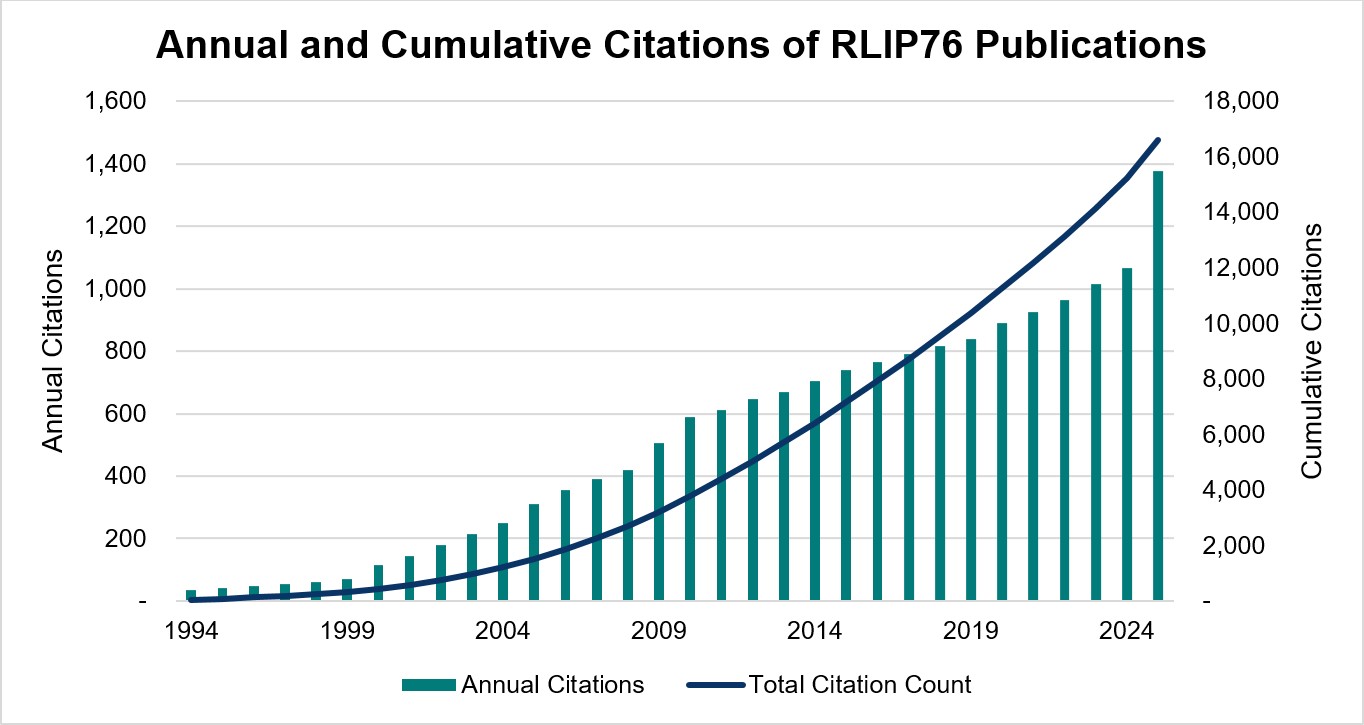
The first, and most obvious, indicator is the number of times the Avesta Bio research has been cited. Avesta Bio research has been spearheaded by Dr. Sanjay Awasthi, and it has been supplemented mostly closely by the work of Dr. Yogesh Awasthi, Dr. Sharad Singhal, and Dr. Sharda Singh in their collaborations with Sanjay. The above graph demonstrates the number of times RLIP76 papers by these four scientists have been cited each year, and how many total citations their papers have.
There are several key takeaways from this graph. First, annual citations have grown quickly and substantially. As noted earlier, the papers from 1994 to 2002 were primarily discovery related. 2003 and the subsequent 5 years saw jumps in citations as work related to an initial thesis surrounding cancer intervention began being published. Further major jumps came in 2008 and 2010 with landmark publications in Clinical Cancer Research and Diabetes. Since 2018, with the introduction of our publication in PNAS, annual citations have continued growing extremely rapidly with over 1,000 citations in each of 2023, 2024, and 2025.
The other major takeaway is the obvious byproduct of this continued adoption by the larger scientific community. The total number of citations by Avesta’s internal group has rapidly accelerated to 16,500+ citations at the present.
| Citation Velocity of Key Internal RLIP76 Papers | |||
| Full Title | Pub Year | Lifetime Velocity | Current Velocity |
| RLIP76 and Cancer | 2008 | 28.3 | 42.5 |
| Novel function of human RLIP76: ATP-dependent transport of glutathione conjugates and doxorubicin | 2000 | 26.3 | 39.5 |
| RLIP76: A versatile transporter and emerging target for cancer therapy | 2010 | 21.2 | 34 |
| Antioxidant role of glutathione S-transferases | 2015 | 28.6 | 31.5 |
| RLIP76: a novel target for Alzheimer’s disease therapy | 2022 | 23.8 | 19 |
| Regression of melanoma in a murine model by RLIP76 depletion | 2006 | 15.2 | 18.2 |
| Role of RLIP76 in glycemic control, lipid metabolism and oxidative stress | 2010 | 11.2 | 18 |
| Regulation of RLIP76 expression by p53 and its role in carcinogenesis | 2020 | 14.2 | 17 |
| RLIP76 is a major determinant of radiation sensitivity | 2005 | 13.1 | 15.7 |
| RLIP76 deficiency and haploinsufficiency: Effects on p53-mediated signaling | 2021 | 15 | 15 |
| Targeting RLIP76 in triple-negative breast cancer: A novel therapeutic approach | 2018 | 17.5 | 14 |
| RLIP76 (RALBP1) is a major determinant of cisplatin-resistance in lung cancer | 2007 | 10.8 | 13 |
| Functional reassembly of ATP-dependent xenobiotic transport by RLIP76 and 70-kDa heat shock protein | 2003 | 9.8 | 11.8 |
| RLIP76 mediates the transport of 4-hydroxynonenal in human cells | 2002 | 8.1 | 9.7 |
| RLIP76-targeted therapy for prostate cancer | 2017 | 10 | 9 |
Citation velocity (shown in the table above) is even more indicative of momentum than the already powerful metric of total citations over time shown previously. Citation velocity is a metric frequently used when measuring the relevance of a paper. There are two relevant forms of this metric, lifetime and current. Lifetime velocity is simply calculated by total number of citations divided by years since publication. This tells how important a paper has been over its lifetime. Current citation velocity is calculated by dividing the citations received over the last 3 years by the length of that period, yielding an average annual citation rate. Current citation velocity is often more informative than lifetime citation velocity because it captures present momentum and current scientific attention, rather than reflecting the cumulative advantage of older papers that have simply had more time to accrue citations. The above table shows the current and lifetime velocity of some of the most important RLIP76 papers published by Avesta’s internal group.
The table reveals a significant difference between the RLIP76 corpus of work and other research areas. In scientific literature, most papers generally lose relevance as they age. In contrast, the RLIP76 corpus shows the opposite: some of our oldest papers dating back 15-25 years have attained even higher current citation velocities than their lifetime scores. This indicates that in the last three years, researchers have come to recognize that RLIP76 is an incredibly important cancer target, and that understanding its biology and utility are critical in the field of cancer research.
The growth is not merely numeric. The citation footprint is broadening because foundational RLIP76 concepts established by Awasthi et al. (the Avesta Bio family of scientists) are now being reused by external investigators in structurally oriented RAL papers, trafficking papers, angiogenesis papers, glioma-metabolism papers, and CNS stress-biology papers rather than only in direct RLIP-depletion oncology-focused studies.[17,18,22,30,32,42-45] The appearance of focused reviews in Cancers, International Review of Cell and Molecular Biology, International Journal of Molecular Sciences, Ageing Research Reviews, and the epilepsy review literature further indicates that the field has become legible to broader specialist communities.[17-19,27,29,30]
External target recognition is also now explicit. The 2012 colorectal-cancer study by Mollberg and colleagues concluded that RalBP1 represented a promising novel therapeutic target.[44] Subsequent external oncology papers repeatedly tied RLIP76 to prognosis, invasion, survival signaling, or therapy response across tumor types.[1-4,7-15,20,26] In parallel, adjacent commercial development around the RAL axis (by Machavert and others) provide evidence that this is not an exclusively academic signaling niche.[30,47,48] Lastly, and most significantly, RLIP76 was recently identified by Roche as an important target for treatment of Clear Cell Renal Carcinoma. [59]
- Comparison with other target-field maturation timelines
The historical pattern around RLIP76 field maturation is consistent with how many biologically important targets mature. The standard trajectory after the first mechanistic discoveries of a novel target never involves immediate therapeutic translational development. More often, a field begins with foundational biology, proceeds through disease association and mechanistic clarification, broadens into pathway and biomarker logic, and only later converges on therapeutic modalities and registration-enabling development. Four well-known comparator fields illustrate that point: Herceptin, Avastin, Gleevec, and Keytruda
Selected comparator target-field timelines
| Target field | Representative discovery benchmark | First U.S. approval benchmark | Critical Importance | Approx. elapsed time |
| HER2 / trastuzumab | 1987 Science paper linking HER2 amplification to relapse and survival in breast cancer.[49] | FDA licensing action for Herceptin in 1998.[50] | Landmark HER2-targeted antibody | 11 years |
| VEGF / bevacizumab | 1989 Science paper describing VEGF as a secreted angiogenic mitogen.[51] | FDA notes Avastin was first approved in 2004.[52] | First anti-angiogenic cancer therapy | 15 years |
| BCR-ABL /
Imatinib |
1990 discovery that the Philadelphia chromosome drives CML and initiation of targeted TKI development for CML. | Gleevec receives FDA approval for CML in 2001 | One of first targeted cancer therapies | 11 years |
| PD-1 / pembrolizumab | 1992 EMBO Journal paper describing PD-1 induction during programmed cell death.[53] | Merck announced first FDA approval of Keytruda in 2014.[54] | First approved PD-1 inhibitor | 22 years |
| RLIP76 /
AV108 |
2005 Cancer Research paper demonstrating that RLIP76 is a major determinant in radiation sensitivity | Potential for conditional approval in 2029 | Potential as first approved RLIP76 inhibitor | 24 years |
These comparators are not mechanistic equivalents of RLIP76, but they are instructive as field-history analogs. In each case, the interval between foundational discovery and first approved therapeutic was measured in more than a decade, and in one case more than two decades.[49-54]
Herceptin and Gleevec are useful comparators not because they are mechanistically identical to RLIP76, but because they show how landmark oncology fields often require long periods of scientific maturation before yielding transformative therapies. In the case of Herceptin, the path to approval was built on years of earlier oncogene biology, HER2 gene identification in the mid-1980s, and the pivotal 1987 finding that HER2 amplification was associated with worse relapse and survival in breast cancer. From there, the field still had to solve major translational challenges, including antibody humanization, validation of HER2 as a functional driver, and the development of a clinically useful diagnostic strategy to identify the right patients. Herceptin entered clinical development in 1992 and was first approved in 1998, but its full impact became even clearer later, including adjuvant use in 2006 and subsequent expansion into gastric cancer and next-generation HER2-directed therapies.
Gleevec followed a similarly extended arc. The underlying biology began with the discovery of the Philadelphia chromosome in 1960, followed by the identification of the translocation mechanism in 1973, the genes involved in the 1980s, and the mechanistic link between that abnormality and CML by 1990. Even then, the field still needed advances in molecular genetics, cytogenetics, and medicinal chemistry before selective kinase inhibition became a realistic therapeutic strategy. Many researchers had doubted whether targeted tyrosine kinase inhibition would even be feasible because kinases were thought to be too structurally similar for selective drug design. Only after those scientific assumptions changed did Dr. Druker and colleagues move imatinib into development, leading to Phase I entry in 1998 and FDA approval in 2001.
Avastin followed a similarly protracted path from biological insight to therapeutic validation. The anti-angiogenesis concept had been proposed decades earlier, but many scientists remained unconvinced that blocking a single angiogenic factor could meaningfully inhibit tumor growth. Even within development, the early champions of anti-VEGF therapy had to persuade others that the approach had real clinical potential. That skepticism makes the eventual outcome especially instructive: once VEGF biology was clarified and bevacizumab showed that targeting this pathway could produce clinical benefit, Avastin became the first FDA-approved therapy specifically developed to target tumor angiogenesis in cancer.
Keytruda illustrates the same broader pattern from the immuno-oncology side. PD-1 was first described in 1992, but it took many years for the field to move from initial biological description to a clear understanding of PD-1 as a therapeutically actionable immune checkpoint. That long gestation was compounded by internal uncertainty: retrospective accounts suggest pembrolizumab came close to being deprioritized at Merck before early clinical data clarified its potential. Yet once the biology, translational strategy, and clinical evidence aligned, pembrolizumab became the first FDA-approved anti-PD-1 therapy in the United States in 2014, and has since grown into a more than $30 billion product, with Merck reporting $31.7 billion in 2025 sales. Its story therefore underscores the same central point as the other comparator fields: even one of the most commercially successful drugs in modern oncology required years of mechanistic validation, organizational conviction, and clinical proof before its significance became obvious.
Taken together, these four case studies point to the same conclusion: long timelines are often a feature of important target classes, not evidence of weak science. In each case, foundational discovery was followed by years of mechanistic refinement, external validation, enabling technology, and evolving clinical strategy before commercial translation was achieved. Herceptin helped establish biomarker-guided targeted antibody therapy, Gleevec helped define precision oncology, Avastin validated anti-angiogenic therapy, and Keytruda helped usher in the checkpoint immunotherapy era. Against that backdrop, the RLIP76 trajectory is more reasonably understood as consistent with the historical maturation pattern seen in other consequential oncology fields.
Conclusion
Taken together, the RLIP76 literature is best characterized as a growing field of science that originated in one research network and has since been progressively externalized, diversified, and mechanistically strengthened. The strongest and most distributed independent evidence remains in oncology, where multiple external groups have reproduced disease relevance and, in some settings, explicitly framed RalBP1 as a therapeutic target.[1-4,7-15,20,26,44]
The most consequential development since 2015 is that the field now extends beyond direct cancer-cell phenotypes into RAL-effector architecture, trafficking, cargo exocytosis, mitochondrial biology, oxidative stress, and CNS-related injury states.[16-30,32,42-45] That broadening matters because it gives RLIP76 a more coherent biological identity: not simply a tumor-associated marker, but a multifunctional node linking transport, stress handling, signaling, and membrane dynamics.[17,18,22,30,42-45]
The publication and curation footprint is now large enough to distinguish between the originating field and the broader external field that has grown around it. The current NCBI bibliography lists 132 PubMed-linked citations and 55 GeneRIF annotations for RALBP1, and this memo focuses on 32 recent external papers drawn from the 92 publications outside Sanjay Awasthi and Sharad Singhal authorship. Viewed alongside the historical timelines of HER2, VEGF, BCR-ABL, and PD-1, the present stage of RLIP76 development is consistent with the normal evolution of a target field from foundational discovery to broader translational relevance.[46,49-54]
Appendix A. H-Index Range
| H-index range | Relative level | Researcher profile this often corresponds to |
| 0-10 | Early career | Graduate student, postdoc, or very early independent researcher still building a citation record |
| 11-20 | Emerging / established early career | Productive early-career researcher or junior faculty member with a growing body of cited work |
| 21-39 | Established | Independent investigator with clear field recognition and a sustained publication record |
| 40-59 | Outstanding | Senior or highly established researcher with broad, durable influence in their discipline |
| 60-69 | Exceptional | Major senior investigator or field-leading scientist with unusually strong and sustained impact |
| 70+ | Top-tier / elite | Exceptionally influential researcher whose body of work places them in the highest echelon of established scientific impact |
The h-index is a research-impact metric that reflects both productivity and influence: a scientist has an h-index of h when they have h papers that have each been cited at least h times. It is widely used because it captures not only how much a researcher has published, but whether that body of work has been consistently recognized and cited by the scientific community. In his original 2005 paper introducing the metric, Jorge E. Hirsch suggested that after about 20 years of scientific activity, an h-index of 20 reflects a successful scientist, 40 an outstanding scientist, and 60 a truly exceptional or “unique” scientist; the table above uses that framework as a practical reference point for interpreting relative levels of scientific achievement. As with any citation metric, h-index should still be read in context, since it can vary significantly by field, database, and career stage.
Appendix B. The focused external 32-paper corpus at a glance
The 32-paper external corpus reviewed in this memo was selected for direct relevance to RLIP76 biology, the broader RAL-effector framework in which RLIP76 functions, or disease translation. The map below is intended as a navigation aid rather than a substitute for the full reference list.
Focused corpus by theme
| Theme | Reference nos. | Representative contribution |
| Oncology and therapy response | 1-4, 7-15, 20, 26 | Expression, prognosis, apoptosis resistance, invasion, microRNA regulation, chemoresponse, glioma metabolism, and renal-cancer drug resistance. |
| Pathway and structural biology | 6, 9, 16-18, 22, 30, 32 | Ral-effector interfaces, stapled peptides, RLIP76 binding-domain engineering, pathway reviews, and the Reps1-Ralbp1-RalA exocytosis module. |
| Oxidative stress and CNS biology | 5, 19, 21, 23-29 | Blood-brain barrier inflammation, neurodegeneration, mitochondrial dysfunction, autopsy-brain studies, perioperative neurocognitive disorders, and epilepsy. |
| Other physiology | 31 | Illustrates that RLIP76-related biology is also being examined outside the oncology and CNS cores, including reproductive physiology. |
References
All 32 references from the focused external corpus are included below, together with the additional historical, contextual, and comparator references used to frame field origin, field growth, and target-maturation timelines.
- Wang CZ, Yuan P, Xu B, Yuan L, Yang HZ, Liu X. RLIP76 expression as a prognostic marker of breast cancer. Eur Rev Med Pharmacol Sci. 2015;19:2105-2111.
- Zhang Y, Song X, Gong W, Zhu Z, Liu X, Hou Q, et al. RLIP76 blockade by siRNA inhibits proliferation, enhances apoptosis, and suppresses invasion in HT29 colon cancer cells. Cell Biochem Biophys. 2015;71:579-585. doi:10.1007/s12013-014-0237-5.
- Yang J, Song Q, Cai Y, Wang P, Wang M, Zhang D. RLIP76-dependent suppression of PI3K/AKT/Bcl-2 pathway by miR-101 induces apoptosis in prostate cancer. Biochem Biophys Res Commun. 2015;463(4):900-906. doi:10.1016/j.bbrc.2015.06.032.
- Fan SY, Jiang JD, Qian J, Lu YC, Hu GH, Luo C, et al. Overexpression of RLIP76 required for proliferation in meningioma is associated with recurrence. PLoS One. 2015;10(5):e0125661. doi:10.1371/journal.pone.0125661.
- Bennani-Baiti B, Toegel S, Viernstein H, Urban E, Noe CR, Bennani-Baiti IM. Inflammation modulates RLIP76/RALBP1 electrophile-glutathione conjugate transporter and housekeeping genes in human blood-brain barrier endothelial cells. PLoS One. 2015;10(9):e0139101. doi:10.1371/journal.pone.0139101.
- Campbell LJ, Peppa M, Crabtree MD, Shafiq A, McGough NF, Mott HR, et al. Thermodynamic mapping of effector protein interfaces with RalA and RalB. Biochemistry. 2015;54(6):1380-1389. doi:10.1021/bi501530u.
- Wang W, Liu J, Qi J, Zhang J, Zhu Q, Ma J, et al. Downregulation of RLIP76 is associated with vincristine resistance in human colorectal cancer HCT-8/VCR cells. Int J Oncol. 2016;49(4):1505-1512. doi:10.3892/ijo.2016.3672.
- Wang W, Liu J, Qi J, Zhang J, Zhu Q, Qin C. RLIP76 decreases apoptosis through Akt/mTOR signaling pathway in gastric cancer. Oncol Rep. 2016;36(4):2216-2224. doi:10.3892/or.2016.5043.
- Thomas JC, Cooper JM, Clayton NS, Wang C, White MA, Abell C, et al. Inhibition of Ral GTPases using a stapled peptide approach. J Biol Chem. 2016;291(35):18310-18325. doi:10.1074/jbc.M116.720243.
- Zhang C, Cai Z, Liang Q, Wang Q, Lu Y, Hu L, et al. RLIP76 depletion enhances autophagic flux in U251 cells. Cell Mol Neurobiol. 2017;37(3):555-562. doi:10.1007/s10571-016-0410-z.
- Liu N, Du CH. RLIP76 silencing inhibits cell proliferation and invasion in melanoma cell line A375. Eur Rev Med Pharmacol Sci. 2017;21(9):2054-2060.
- Zhang LL, Xie FJ, Tang CH, Xu WR, Ding XS, Liang J. miR-340 suppresses tumor growth and enhances chemosensitivity of colorectal cancer by targeting RLIP76. Eur Rev Med Pharmacol Sci. 2017;21:2875-2886.
- Jinesh GG, Kamat AM. RalBP1 and p19-VHL play an oncogenic role, and p30-VHL plays a tumor suppressor role during the blebbishield emergency program. Cell Death Discov. 2017;3:17023. doi:10.1038/cddiscovery.2017.23.
- Ieong C, Ma J, Lai W. RALBP1 regulates oral cancer cells via Akt and is a novel target of miR-148a-3p and miR-148b-3p. J Oral Pathol Med. 2019;48(10):919-928. doi:10.1111/jop.12936.
- Wang Q, Zhang L, Cui Y, Zhang C, Chen H, Gu J, et al. Increased RLIP76 expression in IDH1 wild-type glioblastoma multiforme is associated with worse prognosis. Oncol Rep. 2020;43:188-200. doi:10.3892/or.2019.7394.
- Hurd CA, Brear P, Revell J, Ross S, Mott HR, Owen D. Affinity maturation of the RLIP76 Ral binding domain to inform the design of stapled peptides targeting the Ral GTPases. J Biol Chem. 2021;296:100101. doi:10.1074/jbc.RA120.015735.
- Cornish J, Owen D, Mott HR. RLIP76: a structural and functional triumvirate. Cancers (Basel). 2021;13(9):2206. doi:10.3390/cancers13092206.
- Apken LH, Oeckinghaus A. The RAL signaling network: cancer and beyond. Int Rev Cell Mol Biol. 2021;361:21-105. doi:10.1016/bs.ircmb.2020.10.005.
- Hindle A, Singh SP, Pradeepkiran JA, Bose C, Vijayan M, Kshirsagar S, et al. Rlip76: an unexplored player in neurodegeneration and Alzheimer’s disease? Int J Mol Sci. 2022;23(11):6098. doi:10.3390/ijms23116098.
- Wang Q, Zhang C, Zhu J, Zhang L, Chen H, Qian J, et al. Crucial role of RLIP76 in promoting glycolysis and tumorigenesis by stabilization of HIF-1alpha in glioma cells under hypoxia. Mol Neurobiol. 2022;59:6724-6739. doi:10.1007/s12035-022-02999-w.
- Boughrara W, Chentouf A. The ABCB1, ABCC2 and RALBP1 polymorphisms are associated with carbamazepine response in epileptic patient: a systematic review. Acta Neurol Belg. 2022;122:871-880. doi:10.1007/s13760-022-01920-5.
- Wang S, Chen X, Crisman L, Dou X, Winborn CS, Wan C, et al. Regulation of cargo exocytosis by a Reps1-Ralbp1-RalA module. Sci Adv. 2023;9(8):eade2540. doi:10.1126/sciadv.ade2540.
- Reddy PH, Kshirsagar S, Bose C, Pradeepkiran JA, Hindle A, Singh SP, et al. Rlip reduction induces oxidative stress and mitochondrial dysfunction in mutant tau-expressed immortalized hippocampal neurons: mechanistic insights. Cells. 2023;12(12):1646. doi:10.3390/cells12121646.
- Baig J, Sawant N, Rawat P, Reddy AP, Reddy PH, Kshirsagar S. Abnormal interaction of Rlip with mutant APP/Abeta and phosphorylated tau reduces wild-type Rlip levels and disrupts Rlip function in Alzheimer’s disease. Biochim Biophys Acta Mol Basis Dis. 2024;1870(1):166858. doi:10.1016/j.bbadis.2023.166858.
- Bose C, Kshirsagar S, Vijayan M, Kumar S, Singh SP, Hindle A, et al. The role of RLIP76 in oxidative stress and mitochondrial dysfunction: evidence based on autopsy brains from Alzheimer’s disease patients. Biochim Biophys Acta Mol Basis Dis. 2024;1870(2):166932. doi:10.1016/j.bbadis.2023.166932.
- Chiang IC, Chen SY, Hsu YH, Shahidi F, Yen GC. Pterostilbene and 6-shogaol exhibit inhibitory effects on sunitinib resistance and motility by suppressing the RLIP76-initiated Ras/ERK and Akt/mTOR pathways in renal cancer cells. Eur J Pharmacol. 2024;967:176393. doi:10.1016/j.ejphar.2024.176393.
- Bandaru M, Sultana OF, Islam MA, Rainier A, Reddy PH. Rlip76 in ageing and Alzheimer’s disease: focus on oxidative stress and mitochondrial mechanisms. Ageing Res Rev. 2025;103:102600. doi:10.1016/j.arr.2024.102600.
- Meng F, Cao S, Wu W, Zhang M, Jing Q, Xie Z, et al. Histone lactylation leads to perioperative neurocognitive disorders by promoting the expression of Ralbp1 and inducing excessive mitochondrial fission in hippocampal neurons. Cell Mol Life Sci. 2026;83:112. doi:10.1007/s00018-026-06095-3.
- Bhattacharjee P, Ghosh D, Singh G, Porel P, Aran KR, Debnath B, et al. RLIP76: a versatile ATP-dependent transporter as a pharmacotherapeutic target for epilepsy management. Inflammopharmacology. 2026 Feb 16. doi:10.1007/s10787-026-02147-z.
- Yan C, Theodorescu D. RAL GTPases: biology and potential as therapeutic targets in cancer. Pharmacol Rev. 2018;70(1):1-11. doi:10.1124/pr.117.014092.
- Billhaq DH, Lee S. A potential function of RLIP76 in the ovarian corpus luteum. J Ovarian Res. 2019;12:34. doi:10.1186/s13048-019-0510-8.
- Richardson DS, Spehar JM, Han DT, Chakravarthy PA, Sizemore ST. The RAL enigma: distinct roles of RALA and RALB in cancer. Cells. 2022;11(10):1645. doi:10.3390/cells11101645.
- Awasthi S, Singhal SS, Srivastava SK, Zimniak P, Bajpai KK, Saxena M, et al. Adenosine triphosphate-dependent transport of doxorubicin, daunomycin, and vinblastine in human tissues by a mechanism distinct from the P-glycoprotein. J Clin Invest. 1994;93(3):958-965. doi:10.1172/JCI117102.
- Awasthi S, Cheng J, Singhal SS, Saini MK, Pandya U, Pikula S, et al. Novel function of human RLIP76: ATP-dependent transport of glutathione conjugates and doxorubicin. Biochemistry. 2000;39(31):9327-9334. doi:10.1021/bi992964c.
- Awasthi S, Sharma R, Singhal SS, Zimniak P, Awasthi YC. RLIP76, a novel transporter catalyzing ATP-dependent efflux of xenobiotics. Drug Metab Dispos. 2002;30(12):1300-1310. doi:10.1124/dmd.30.12.1300.
- Awasthi S, Singhal SS, Sharma R, Zimniak P, Awasthi YC. Transport of glutathione conjugates and chemotherapeutic drugs by RLIP76 (RALBP1): a novel link between G-protein and tyrosine kinase signaling and drug resistance. Int J Cancer. 2003;106(5):635-646. doi:10.1002/ijc.11260.
- Awasthi S, Singhal SS, Yadav S, Singhal J, Drake K, Nadkar A, et al. RLIP76 is a major determinant of radiation sensitivity. Cancer Res. 2005;65(14):6022-6028. doi:10.1158/0008-5472.CAN-05-0968.
- Singhal SS, Singhal J, Yadav S, Sahu M, Awasthi YC, Awasthi S. RLIP76: a target for kidney cancer therapy. Cancer Res. 2009;69(10):4244-4251. doi:10.1158/0008-5472.CAN-08-3521.
- Awasthi S, Singhal SS, Yadav S, Singhal J, Vatsyayan R, Zajac E, et al. A central role of RLIP76 in regulation of glycemic control. Diabetes. 2010;59(3):714-725. doi:10.2337/db09-0911.
- Singhal SS, Wickramarachchi D, Yadav S, Singhal J, Leake K, Vatsyayan R, et al. Glutathione-conjugate transport by RLIP76 is required for clathrin-dependent endocytosis and chemical carcinogenesis. Mol Cancer Ther. 2011;10(1):16-28. doi:10.1158/1535-7163.MCT-10-0699.
- Lee S, Wurtzel JGT, Singhal SS, Awasthi S, Goldfinger LE. RALBP1/RLIP76 depletion in mice suppresses tumor growth by inhibiting tumor neovascularization. Cancer Res. 2012;72(20):5165-5173. doi:10.1158/0008-5472.CAN-12-0468.
- Goldfinger LE, Ptak C, Jeffery ED, Shabanowitz J, Hunt DF, Ginsberg MH. RLIP76 (RalBP1) is an R-Ras effector that mediates adhesion-dependent Rac activation and cell migration. J Cell Biol. 2006;174(6):877-888. doi:10.1083/jcb.200603111.
- Kashatus DF, Lim KH, Brady DC, Pershing NLK, Cox AD, Counter CM. RALA and RALBP1 regulate mitochondrial fission at mitosis. Nat Cell Biol. 2011;13(9):1108-1115. doi:10.1038/ncb2310.
- Mollberg NM, Steinert G, Aigner M, Hamm A, Lin FJ, Elbers H, et al. Overexpression of RalBP1 in colorectal cancer is an independent predictor of poor survival and early tumor relapse. Cancer Biol Ther. 2012;13(8):694-700. doi:10.4161/cbt.20087.
- Lee S, Goldfinger LE. RLIP76 regulates HIF-1 activity, VEGF expression and secretion in tumor cells, and secretome transactivation of endothelial cells. FASEB J. 2014;28(9):4158-4168. doi:10.1096/fj.14-255711.
- National Center for Biotechnology Information. Gene: RALBP1 RalA binding protein 1 [Internet]. Bethesda (MD): National Library of Medicine (US); [cited 2026 Mar 18]. Available from: https://www.ncbi.nlm.nih.gov/gene/10928
- Machavert Pharmaceuticals. Science [Internet]. [cited 2026 Mar 18]. Available from: https://machavert.com/science/
- Machavert Pharmaceuticals. Dan Theodorescu [Internet]. [cited 2026 Mar 18]. Available from: https://machavert.com/team/dan-theodorescu/
- Slamon DJ, Clark GM, Wong SG, Levin WJ, Ullrich A, McGuire WL. Human breast cancer: correlation of relapse and survival with amplification of the HER-2/neu oncogene. Science. 1987;235(4785):177-182. doi:10.1126/science.3798106.
- U.S. Food and Drug Administration. Trastuzumab – product approval information – licensing action [Internet]. 1998 Sep 25 [cited 2026 Mar 18]. Available from: https://www.accessdata.fda.gov/drugsatfda_docs/appletter/1998/trasgen092598L.htm
- Leung DW, Cachianes G, Kuang WJ, Goeddel DV, Ferrara N. Vascular endothelial growth factor is a secreted angiogenic mitogen. Science. 1989;246(4935):1306-1309. doi:10.1126/science.2479986.
- U.S. Food and Drug Administration. Avastin (bevacizumab) information [Internet]. 2010 Dec 16 [cited 2026 Mar 18]. Available from: https://www.fda.gov/drugs/postmarket-drug-safety-information-patients-and-providers/avastin-bevacizumab-information
- Ishida Y, Agata Y, Shibahara K, Honjo T. Induced expression of PD-1, a novel member of the immunoglobulin gene superfamily, upon programmed cell death. EMBO J. 1992;11(11):3887-3895. doi:10.1002/j.1460-2075.1992.tb05481.x.
- Merck & Co., Inc. Merck receives accelerated approval of KEYTRUDA (pembrolizumab), the first FDA-approved anti-PD-1 therapy [Internet]. 2014 Sep 4 [cited 2026 Mar 18]. Available from: https://www.merck.com/news/merck-receives-accelerated-approval-of-keytruda-pembrolizumab-the-first-fda-approved-anti-pd-1-therapy/
- UTMB Health Research Expert Profiles. RLIP76 is a major determinant of radiation sensitivity [Internet]. Galveston (TX): The University of Texas Medical Branch; [cited 2026 Mar 18]. Available from: https://researchexperts.utmb.edu/en/publications/rlip76-is-a-major-determinant-of-radiation-sensitivity/
- University of Texas Southwestern Medical Center. RLIP76 and Cancer [Internet]. Dallas (TX): UT Southwestern; [cited 2026 Mar 18]. Available from: https://utsouthwestern.elsevierpure.com/en/publications/rlip76-and-cancer/
- OUCI. RLIP76 Transports Vinorelbine and Mediates Drug Resistance in Non-Small Cell Lung Cancer [Internet]. [cited 2026 Mar 18]. Available from: https://ouci.dntb.gov.ua/en/works/45oD2MD9/
- Mendeley. RLIP76: a target for kidney cancer therapy [Internet]. [cited 2026 Mar 18]. Available from: https://www.mendeley.com/catalogue/a23c71c7-605d-3f04-8826-fef541572dd6/
- Weidle UH, Nopora A. Clear Cell Renal Carcinoma: MicroRNAs With Efficacy in Preclinical In VivoModels. Cancer Genomics Proteomics. 2021 May-Jun;18(3 Suppl):349-368. doi: 10.21873/cgp.20265. Epub 2021 May 15. PMID: 33994361; PMCID: PMC8240043.